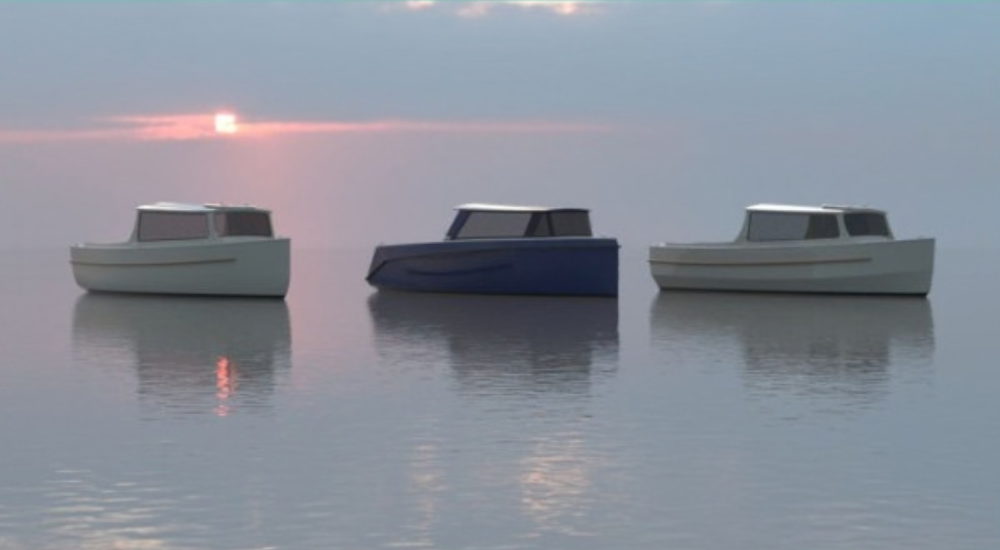
Kerrier Marine is a Cornwall based marine design business focused on developing practical, lower-carbon leisure vessels for use in coastal environments and tidal estuaries.
The company is exploring how modern vessel design, electric propulsion and carefully selected materials can support more sustainable boating and tourism activities.
As part of the development of a 16-foot hire vessel concept, Kerrier Marine wanted to ensure that key engineering decisions were informed by robust environmental data rather than assumptions.
Grant Funded by Innovate UK, Carbon Sense and The Way To Do was engaged to carry out a Life Cycle Assessment (LCA) to evaluate the environmental impact of different propulsion systems and hull material options.
Small leisure vessels traditionally rely on petrol outboard engines, which generate emissions throughout their operational life.
Kerrier Marine wanted to understand how design decisions could influence the lifetime carbon footprint of a small leisure vessel, particularly in relation to propulsion and material selection.
The key objectives were to:
• Compare electric propulsion with traditional petrol outboard engines
• Assess the carbon implications of different hull materials, including aluminium, recycled aluminium and composite options
• Understand emissions over both short-term operation and a 30-year vessel lifespan
• Evaluate how electricity supply (grid vs renewable electricity) influences operational emissions
The aim was to produce clear, decision-ready insight that could inform engineering choices, investment planning and future discussions with customers and partners.
Carbon Sense and The Way To Do carried out a comparative Life Cycle Assessment examining the factors that most strongly influence emissions across the lifecycle of a small leisure vessel. The analysis considered both embodied emissions from materials and manufacturing and operational emissions from propulsion systems over time.
The study assessed:
• Electric propulsion compared with petrol outboard engines
• Hull material options including aluminium, recycled aluminium and composite materials
• Environmental performance over both one year and 30 year operational scenarios
• Electricity supply scenarios using standard grid electricity and renewable electricity
This approach allowed Kerrier Marine to understand not only the initial carbon impact of vessel construction, but also how emissions accumulate over decades of use, maintenance and component replacement.
The Life Cycle Assessment provided clear insights to support Kerrier Marine’s vessel design decisions.
The most significant finding was significant potential lifecycle emissions advantage of electric propulsion. While electric systems can have slightly higher upfront material impacts, these are quickly outweighed by emissions associated with petrol fuel use.
Over a 30-year operating life, petrol-powered vessels continue to emit carbon through fuel combustion and engine replacement, whereas electric propulsion avoids fuel emissions entirely and requires fewer major component replacements, resulting in a substantially lower lifetime carbon footprint.
The assessment also highlighted the importance of hull material selection once propulsion emissions are reduced. Recycled aluminium and flax/PET composite hulls demonstrated strong performance due to lower embodied carbon, durability and improved end-of-life recyclability potential.
As a result of the study, Kerrier Marine was able to:
• Confirm electric propulsion as the most effective route to reducing vessel emissions
• Focus further development on recycled aluminium and flax/PET hull options
• Strengthen its sustainability narrative with evidence-based analysis
• Support future investment and funding discussions with credible environmental data
The project demonstrates how early-stage lifecycle analysis can support lower-carbon innovation within the marine sector, enabling better engineering decisions from the outset.
Find out more about Kerrier Marine and follow the project progress here: Kerrier Marrine (Take a Turn Yachting Ltd)