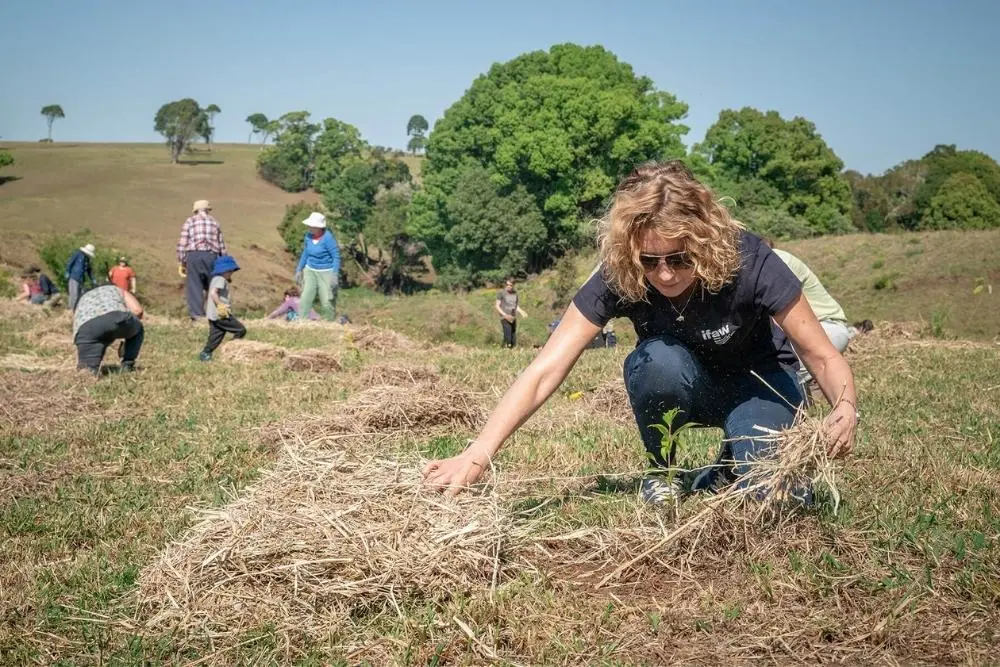
Nature-based solutions are increasingly being used by organisations to address carbon emissions. When applied carefully, they can play a meaningful role in a credible, reduction-led Net Zero strategy, particularly where unavoidable and residual emissions remain.
Carbon Sense was proud to work with Stephens Scown, a B Corp law firm in the South West, supporting its approach to address residual emissions and supporting consideration of how residual emissions could be addressed through a locally rooted nature-based solution delivered in partnership with Plant One.
Stephens Scown set an ambitious target to achieve Net Zero carbon emissions by the end of 2025 and now publicly states that they have made extraordinary progress towards their goal. As a certified B Corp, this commitment sits within a broader impact agenda that includes governance, client work, procurement, and community engagement across the South West.
The firm’s approach focused first on emissions reduction. Through measures such as refurbishing buildings to improve energy efficiency, Stephens Scown reduced its Scope 1 and 2 emissions by approximately 71 percent before addressing remaining emissions.
“Our goal was to achieve Net Zero by the end of 2025, and we're pleased to announce that we have reached that ambitious target.
This year, we successfully reduced our carbon footprint by a further 26% thanks to refurbishing our buildings to make them more energy efficient, a Net Zero Hero campaign encouraging colleagues to reduce their energy use in areas that have the most impact, and the introduction of an electric pool car.
That has helped us to be in a place where we can offset the remaining Scope 1,2, and 3 emissions via two projects, forest restoration in Nicaragua, and via Plant One in Cornwall.” - Stephens Scown
Carbon Sense contacted by Stephens Scown to support the identification and selection of offsetting schemes.
Once residual emissions had been identified by the firm, Carbon Sense worked together with Stephens Scown and Plant One, a Cornwall-based organisation focused on woodland restoration and landscape recovery.
Plant One’s approach is grounded in the idea that forests, rivers, and oceans are part of a single, interconnected living system. Rather than viewing tree planting in isolation, the organisation focuses on restoring entire catchments, recognising how nutrients, energy, biodiversity, and carbon flow between land and sea.
This systems-based perspective closely aligns with our own approach to sustainability, where carbon is addressed as part of wider environmental processes rather than as a standalone metric.
Plant One captures this thinking in a short film exploring the connection between forests, rivers, and oceans, and the role people can play in restoring these systems:
“I’m convinced there is absolutely nothing stopping us from restoring our planet. We have the opportunity to create a new story about why trees are among the most valuable and powerful solutions we should be focusing on.” – Plant One
More about Plant One’s work can be found here
This work highlights several principles that are becoming increasingly important for organisations using nature-based solutions as part of a Net Zero strategy:
For Stephens Scown, this approach supports its B Corp commitments while reinforcing leadership on Net Zero in the South West.
While carbon accounting remains central, a blended package of verified credits, and nature-based solutions can deliver wider benefits when chosen carefully. Woodland restoration supports biodiversity, landscape resilience, and long-term environmental health, while also helping organisations connect climate action to place.
For professional services firms, this kind of blended approach aligns environmental responsibility with ESG commitments, client expectations, and long-term reputation, without relying on simplistic offsetting strategies.
Carbon Sense supports organisations to design credible, reduction-first Net Zero strategies. We support organisations to measure emissions, prioritise reductions, and address unavoidable and residual emissions responsibly through carefully selected nature-based solutions.
Where appropriate, we also help organisations identify trusted local partners and projects that deliver genuine environmental value.
To discuss how nature-based solutions could form part of your Net Zero strategy, contact Carbon Sense
What are nature-based solutions in a Net Zero strategy?
Nature-based solutions use natural processes, such as woodland restoration, to help address unavoidable and residual emissions after meaningful reductions have been made.
Are tree planting projects suitable for addressing residual emissions?
They can be, provided projects are well designed, locally appropriate, and used as part of a wider reduction-led strategy rather than as a substitute for cutting emissions.
How should organisations talk about residual emissions responsibly?
By being clear about what has been reduced, what remains unavoidable, and how residual emissions are being addressed using transparent and credible methods.

Truro City Council has begun a three-year partnership with Cornwall-based carbon accounting and sustainability consultancy Carbon Sense, marking a significant step in the Council's journey towards Net Zero. The partnership will support the Council's approach to carbon management and help translate environmental ambition into on-the-ground improvements across its operations.
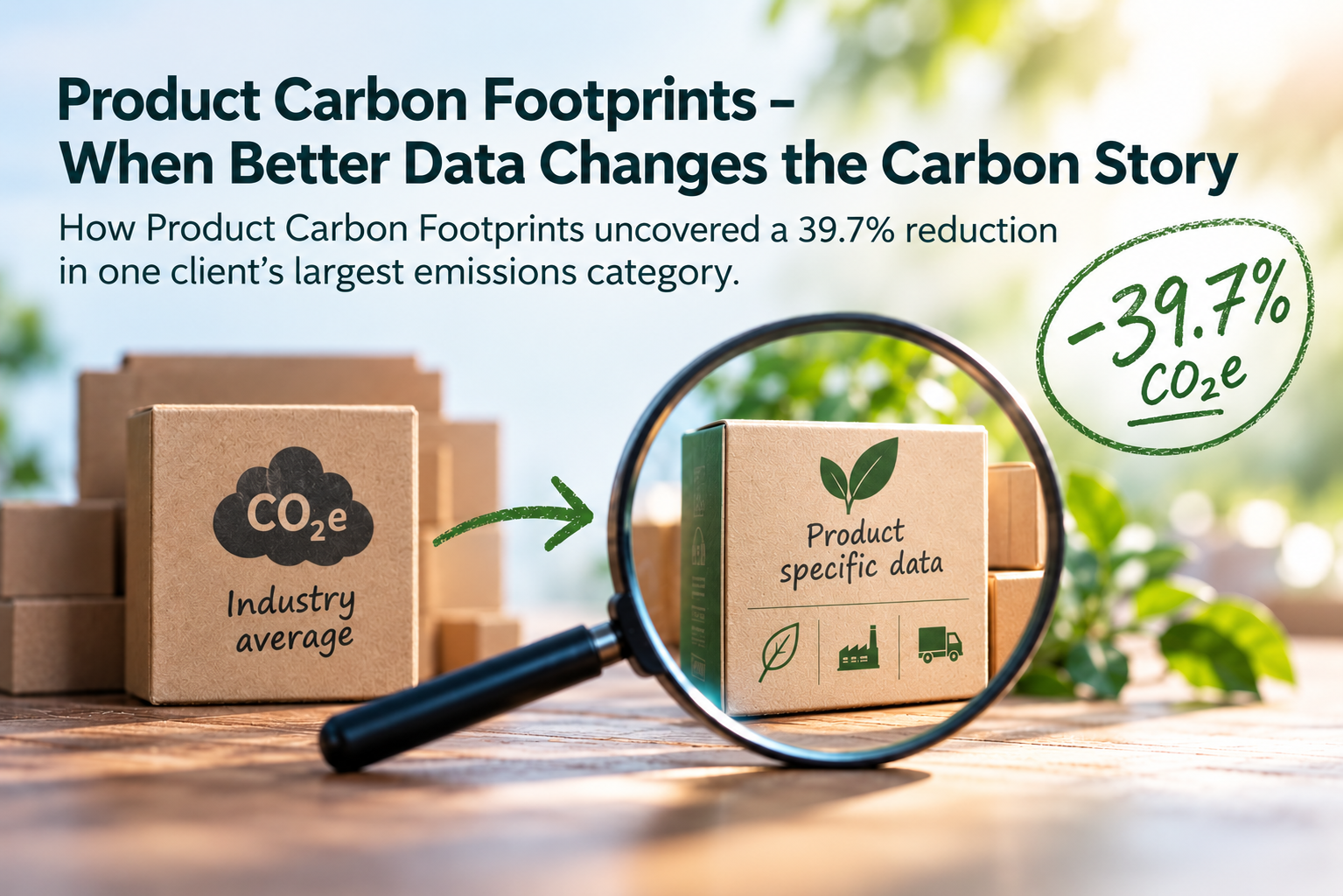
A Product Carbon Footprint can change more than a number. It can change how an organisation understands its emissions, sets its targets and makes purchasing decisions, replacing assumptions with evidence and creating a stronger foundation for genuine carbon reduction.

Digital Product Passports (DPPs) are set to change how manufacturers collect, manage and share product information. This article explains what DPPs mean for UK manufacturers supplying the EU, key implementation dates and how Product Carbon Footprints, Life Cycle Assessments and reliable supply chain data can help businesses prepare.

Across the UK, organisations are putting off their carbon footprint work. Budget pressure, competing priorities, and uncertainty about what the process involves are all cited as reasons. For many, it feels like something that can wait until conditions improve.

The UK care sector is a large and diverse part of the healthcare system, with around 15,000 residential and nursing care homes, alongside thousands of community healthcare providers, dental practices and domiciliary care services operating across the country.

UK manufacturing accounts for approximately 11 per cent of the country's total greenhouse gas emissions. From energy-intensive processing to complex multi-material supply chains, the sector faces a carbon management challenge that is both operationally complex, and commercially urgent.

Could CBAM affect your business? Understand what the EU and UK schemes mean for your supply chain and find out how ready you are with our free 2–3 minute CBAM Readiness Assessment.

Many organisations assume that bringing a new supplier into their supply chain will automatically increase their carbon footprint. In practice, however, the opposite can sometimes be true. The right supplier, with more efficient processes, better environmental performance or lower-carbon products and services, can actually help reduce emissions across your wider value chain.

Embodied carbon is rapidly becoming one of the biggest climate challenges in construction. In this article we explore how circular building design and design for disassembly can reduce emissions from the outset, turning buildings into future material assets rather than demolition waste.

Organisations receiving Cornwall’s Good Growth or Shared Prosperity Fund support may now need Environmental Growth Action Plans or Carbon Reduction Plans. Learn what this means and how businesses can respond.
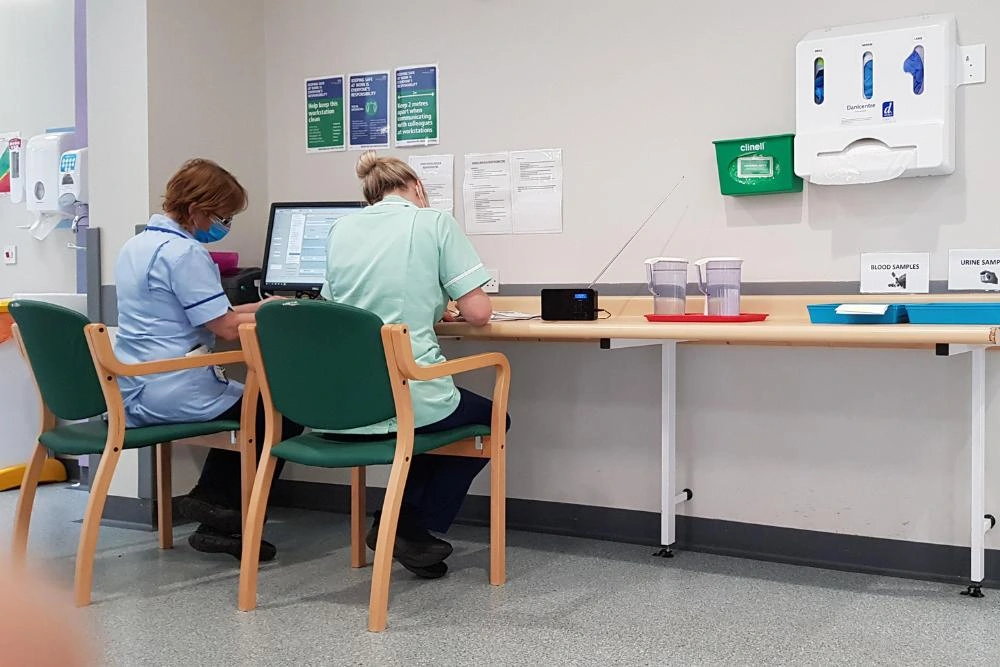
Many organisations supplying the NHS are discovering that robust carbon reporting is becoming a core requirement for future contracts. The key is to start early - measure emissions properly, build a credible reduction plan, and ensure reporting is clear and transparent.

A climate action plan is typically more comprehensive and strategic. It goes beyond compliance to include long-term decarbonisation pathways, stakeholder accountability, and integration into corporate governance.
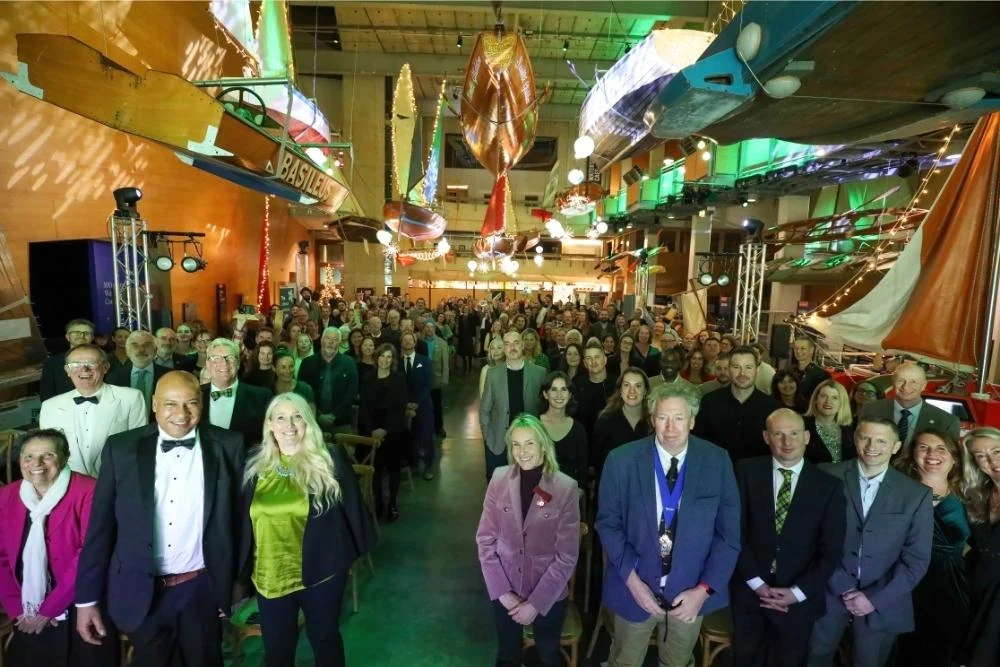
The Carbon Sense team had the pleasure of attending the Cornwall and Isles of Scilly Sustainability Awards, and were honoured to sponsor two categories in 2025, Low Carbon Leader and Most Sustainable Organisation, and to present the trophies to three outstanding winners.
Nature-based solutions are increasingly being used by organisations to address carbon emissions. When applied carefully, they can play a meaningful role in a credible, reduction-led Net Zero strategy, particularly where unavoidable and residual emissions remain.
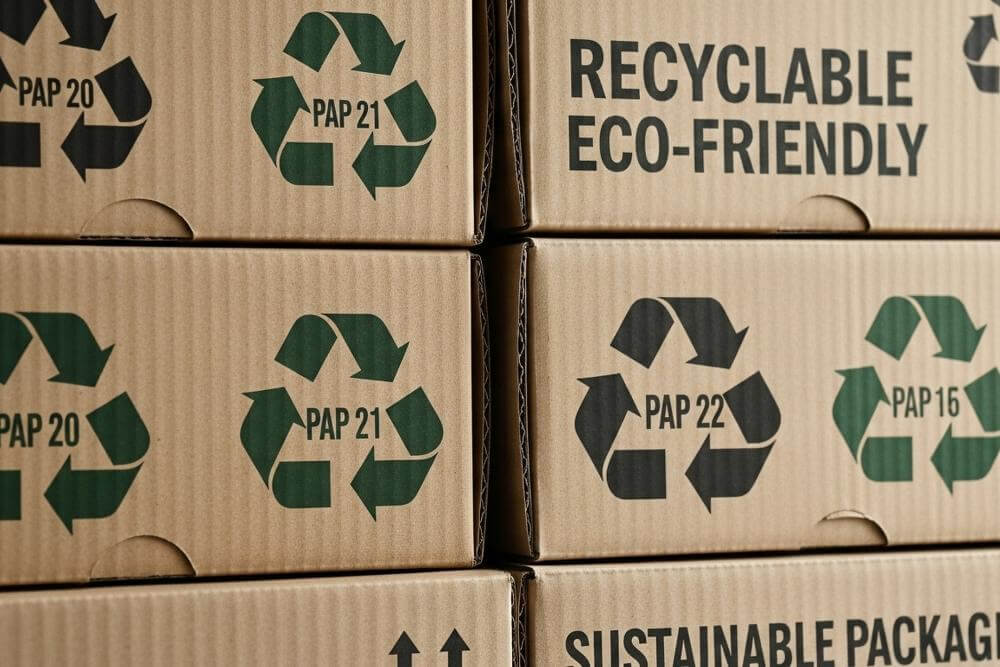
Developing an EPD can ensure you meet tender requirements, as well as providing an opportunity to understand and reduce the true environmental impact of your products.

Understanding the Transition from SECR to UK SRS. The UK government is replacing the current Streamlined Energy and Carbon Reporting (SECR) framework with the more comprehensive UK Sustainability Reporting Standards (UK SRS).

As part of its Net Zero Supplier Roadmap, the NHS has announced that by April 2027, all suppliers, including those providing food, medical products, and services, will be required to submit a comprehensive Carbon Reduction Plan (CRP).

Carbon Sense is your expert partner in carbon reduction. We support UK organisations to understand, measure, and reduce their carbon footprint, save energy, and make sense of sustainability. With a practical, no-nonsense approach, we help you achieve Net Zero goals while protecting your bottom line.

"We are excited to support the awards this year and are honoured to sponsor the Carbon Positive category. At this crucial time, carbon mitigation and an embedded strategy to achieve Net Zero are vital to avoid further climate change catastrophes".

In a world increasingly focused on sustainability, Carbon Literacy has emerged as an essential tool for businesses seeking to reduce their environmental impact. Carbon Sense understands the value and benefits of Carbon Literacy Training whether for a team within your business, or for your entire organisation.

A carbon reduction or decarbonisation plan is a set of strategies and actions that an organisation, community, or government implements to reduce its carbon footprint and mitigate the effects of climate change.

Carbon credits, and their differences, is a frequent topic of discussion. When developing a sustainability strategy or communicating about sustainability, its essential for businesses to understand these differences

Pathway to Net Zero, launched in November 2023 is a fully funded support programme helping businesses adopt more environmentally conscious processes and move towards becoming Net Zero.

The future still remains uncertain so considering options to reduce energy consumption to rely less on the grid is becoming more and more necessary.

Climate change has become a key issue for us all. With scientific reports being released every day, we now know more about the changes that are happening to the Earth’s systems.

The impact of the industrial revolution has created a climate where pretty much all our activities have an impact on the environment.

By reducing your organisation’s carbon footprint you can reduce your impact on the environment and resources.

There is a wealth of research being undertaken by the leading academics studying climate change and assessing how we can build climate resilience and reduce risk.

It is important to get good advice to ensure that you avoid the common pitfalls and have a plan that works for you and achieves genuine environmental benefits.